
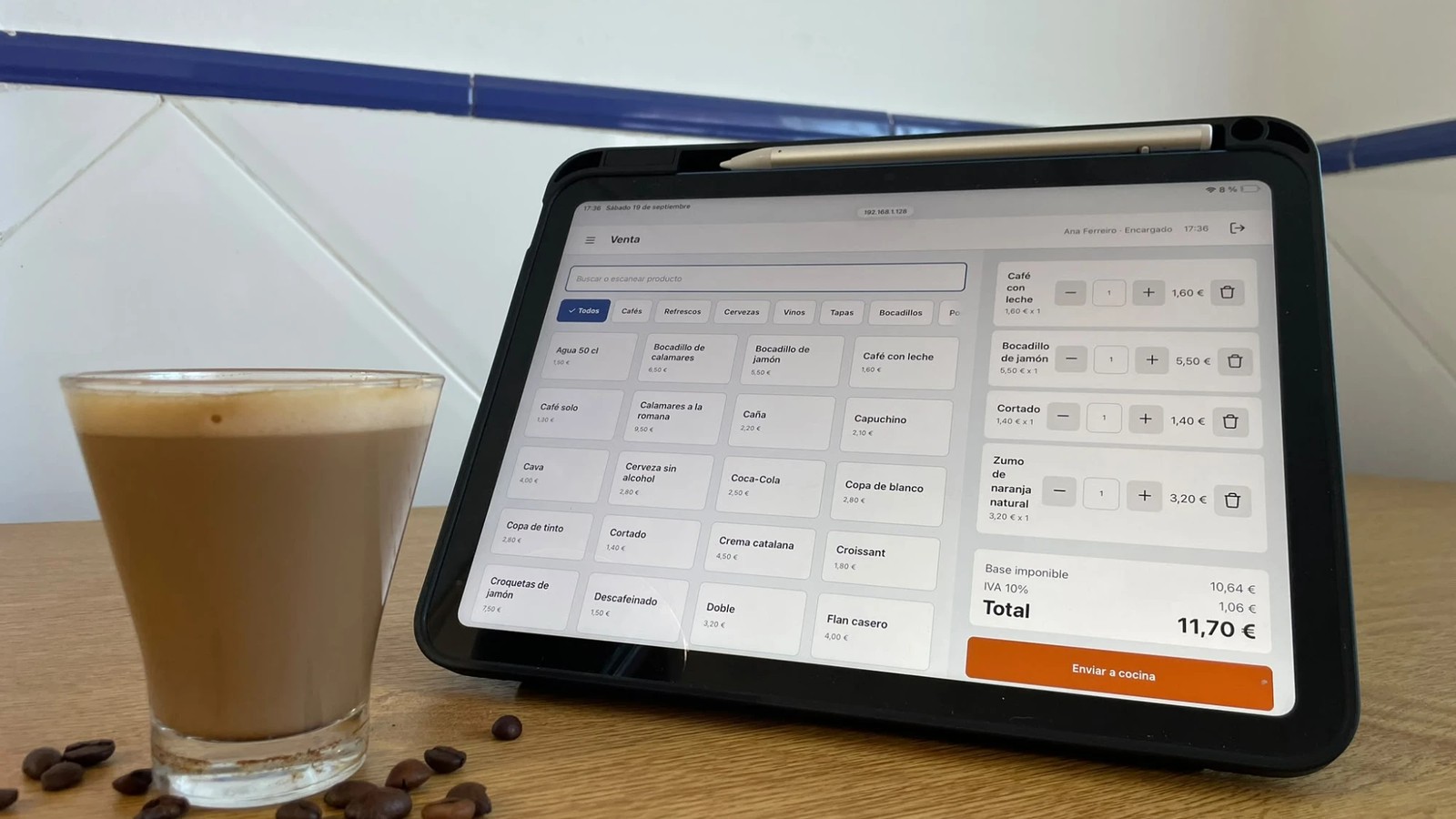
Run the counter, the tables and the kitchen, with ease.
Run the counter, the tables and the kitchen of your bar, restaurant, café or brunch place with a POS that runs on the shop's computer.
Sample names and prices.
Why Komos
- It arrives ready. Plug the box in, type the setup code from its label and start selling.
- It keeps taking payments when the internet goes down. The counter, the tables and the kitchen carry on inside the venue. How the licence works
- Nobody gets in from outside the venue. Nobody connects to the till from outside the venue's network, to use it or to look inside. Who can get into the till
- The invoice record VeriFactu requires, from the very first ticket. VeriFactu ready. What "VeriFactu ready" means
Sell at the counter and at the table
Everyone signs in with their own PIN, as a waiter or a manager, and sells from a catalogue with VAT-inclusive prices.
- Search by name or with the barcode scanner, which types straight into the till.
- Categories including "Top sellers": the ten products sold most in the last 30 days, the same everywhere at the counter.
- A product can sit in several categories at once.
- Totals show the taxable base and VAT for each rate, worked out line by line.
- Works the same at a bar, a restaurant, a café or a brunch place.
- No discounts, promotions, price overrides or sale by weight.
Tables, open tabs and a kitchen ticket
Any order can be held on a table, or paid straight away instead, and each area of the venue has its own floor plan.
- Open tabs lists every table, with item count, total and elapsed time; reopening one restores its lines exactly.
- The manager places, resizes and duplicates tables by dragging them on the plan, which always opens locked.
- When a kitchen printer is set up, "Send to kitchen" prints the table, the time, who is serving and each new line, no prices.
- With no printer configured, the button does not appear and everything else works the same.
- There is no kitchen display screen, no courses, no routing between stations and no merging of tabs between tables.

Take payment, print the ticket, close the day
Payment is cash, card, or both at once, and cash change is calculated automatically.
- No card data of any kind ever enters the system.
- The ticket carries the venue's name, series and number, date, lines, base and VAT per rate, total, tender type and who served.
- Reprinting marks the copy "COPIA" and never creates a second record.
- A manager can annul a ticket the same day; the original stays as it was and a separate annulment record is written.
- The day's sales list shows every sale with its totals, and can be printed.
The invoice record VeriFactu requires
From the very first ticket, every payment and every cancellation leaves a chained, numbered record, shaped the way VeriFactu requires.
VeriFactu ready: today Komos keeps that record in the venue; signing it and sending it to the tax agency are outside the product. What "VeriFactu ready" means
- Every ticket is a simplified invoice (F2), valid up to 3.000 € including VAT; the till refuses payment above that amount.
- The customer's name, tax ID or ID card number is never requested, stored or printed.
- The rest of the legal detail is in the FAQ.
Equipment and network
The shop's computer runs the till, the database and the receipt printer.
- An Android tablet at the counter is the till; a phone running the same software takes orders at the table.
- Optionally, a second computer with its own printer in the kitchen.
- The tablet finds the computer by itself, on the shop's network.
When the internet goes down, it keeps taking payment, holding tabs and printing tickets. How the licence works.
Search answers instantly and the ticket comes out straight away once payment is confirmed.
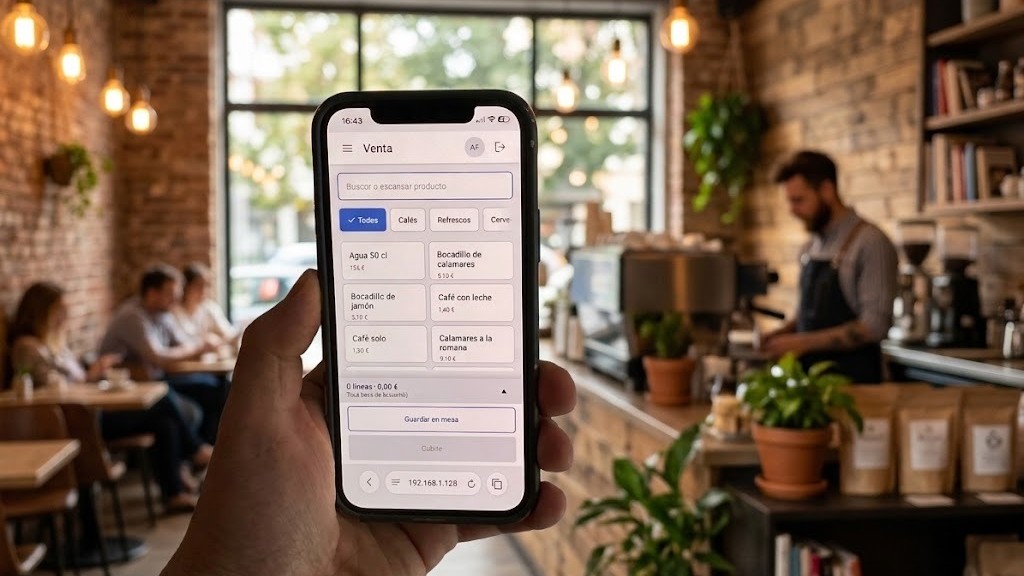
Illustrative image.
Updates, backup and a guided first run
The system prepares every sale to upload to the company's staging area, reports its own health, and can make an encrypted backup off-site.
- From the app, a manager installs a new version only after confirming; nothing installs on its own.
- If the new version fails its own check, the previous one takes over with nothing for anyone to do; a manager can also go back to the previous version.
- On a new installation, the first screen asks for the setup code printed on the card's label, then for the first manager to be created — a name and a PIN, entered twice — before the usual sign-in screen appears.
- If someone tries to guess a PIN, the system locks that user; a manager unlocks them from the users screen.
Frequently asked questions
What does "VeriFactu ready" mean?
The system does not sign or send anything to the tax agency: it holds no electronic certificate and carries no formal self-declaration, and it does not state that it satisfies the legal requirements for electronic invoicing; it is a foundation built for a future integration, not a verified system today. This page is not legal advice, and it does not state that any authority has reviewed the product.
What happens if the till goes 30 days with no connection?
The till needs an internet connection when it is installed and at least once every 30 days to renew its licence, always counted from the last renewal. If that time runs out with no renewal, it keeps selling for 48 more hours — showing the stop date on screen throughout — and then stops. Data is never deleted: renewing the licence brings it back with all its data intact and starts a new 30 days.
Can anyone at the company access my till?
Nobody can connect to the till from outside the shop's network to operate it or look into it. The only thing the company can do, on its own, to a running till is renew or withdraw its licence; withdrawing it leads to the same result as not renewing, with the data always intact.
Does each shop run on its own?
Yes. Each shop is an independent installation: one business, one tax ID. There is no managing several shops at once, no franchise and no fleet of tills controlled from outside.
What does Komos not do?
- It does not integrate with any card terminal.
- It does not manage stock, suppliers, customers or loyalty.
- It does not manage several shops at once.
- It sends nothing to the tax agency.
Is it already running at a business?
The product is in development: it does not yet run at any real business. No availability date or price is given. We want to meet our first venues
We are looking for our first venues
We are looking for a few bars, restaurants and cafés that want to be the first to use Komos and tell us what it needs. Komos is in development and is not yet running in any business, which is why we want to work closely with those first venues. The contact address will be published here shortly.